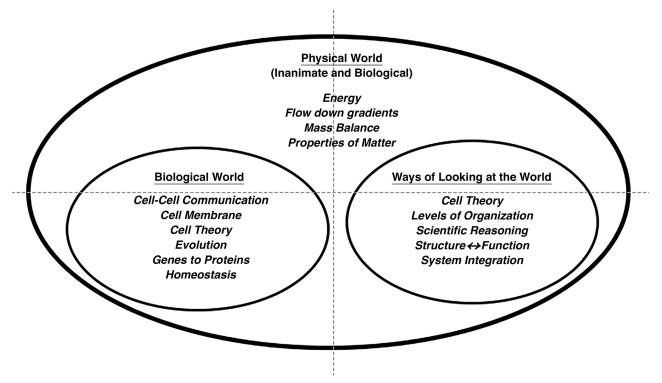
From How to Help Students Understand Physiology? Emphasize General Models by Harold I. Modell...
| General Model | Components | Relevant Topics |
|---|---|---|
| Control systems | • Sensor • Comparator • Controller • "Set point" • Feedback signal |
• Regulation • Negative feedback • Positive feedback • Feed forward |
| Conservation of mass | "Compartment" with input and output | • Mass balance • Indicator dilution |
| Mass and heat flow | • Driving force • Resistance • Flow |
• Pressure-flow relationships • Diffusion • Osmosis • Ion flow • Heat flow |
| Elastic properties of tissues | • Transmural pressure • Compliance (1/recoil) |
• Pressure-volume relationships • Length-recoil relationships |
| Transport across membranes | • Driving force • Lipid bilayer • "Permeability" |
• Simple diffusion • Osmosis • Carrier-mediated transport (facilitated diffusion, co-transport, primary active transport) |
| Cell-to-cell communication | • Signal molecule (or ion) • Receptor |
• Chemical synapses • Electrical synapses • Hormone action • Paracrines |
| Molecular interaction | • Reactants • Products |
• Mass action • Equilibrium/dissociation constants • Ligand binding |
From Another look at the core concepts of physiology: revisions and resources by Joel Michael and Jenny McFarland...
| Core Concept | Definition | Explanation |
|---|---|---|
| 1. Cell-Cell Communication | In a living organism, cells must pass information to one another to coordinate their activities. | Cells communicate with one another using different mechanisms: generation and transport of endocrine signals, generation and transmission of neural (electrical) signals, and cell-cell contact. |
| 2. Cell Membrane | Cell plasma membranes are complex structures that determine what, and how, substances enter or leave the cell. Cell membranes also play an important role in generating and receiving signals from each other. | Every cell has a membrane separating the consituents of the cell from the extracellular compartment, and in general, from other cells. Every physiological phenomenon (function) ultimately depends on the behavior of cells and their membranes. |
| 3. Cell Theory | All cells arise from other cells and, thus, have the same DNA as their parent cell. All cells making up the organism have the same DNA. Cells have many functions in common, but cells also have many specialized functions that are required by the organism. | Cell theory is one of the oldest concepts in modern biology. Although physiology students are introduced to this concept in other biology courses, it has physiological implications that may not be obvious to students. |
| 4. Energy | The maintenance of the life of the organism requires the constant expenditure of energy. The acquisition, transformation, and transportation of energy are essential functions of the body. | Ingestion of food, digestion, and the generation of ATP (the energy source for most biological processes) are steps in the process of providing every cell with the energy needed to function and survive. Students are introduced to this concept in other biology and science courses and should be able to apply it to physiological processes. |
| 5. Evolution | Evolution is genetic change within a population over time. Three mechanisms drive this change: variation (gene mutation), inheritance, and selection. | Living organisms share a common ancestor, and the process of evolution has resulted in the present-day variety of species. The mechanisms of evolution act at many levels of organization and result in adaptive changes that have produced the extant relationships between biological structure and physiological function. This concept is often not addressed in physiology courses; however, students are introduced to the concept of evolution in other biology courses. |
| 6. Flow Down Gradients (Flux) | The transport of "stuff" (ions, molecules, fluids, and gas) is a central process at all levels of organization in the organism, and a simple model describes such transport. | Ions or other solutes crossing a cell membrane, blood flowing in blood vessels, gas flowing in airways, and chyme moving down the gastrointestinal tract are all processes that result from the interaction of an energy gradient and the resistance to flow that is present. It is likely that students have encountered this concept in previous science courses, but they need help to transfer this understanding to physiology. This core concept does not incorporate active transport mechanisms. |
| 7. Genes to Proteins | The genes (DNA) of every organism code for, and contain information needed for, the synthesis of proteins (enzymes and structural proteins). The genes that are expressed in a cell determine the structure and functions of that cell. | This is the central dogma of molecular biology, and it explains both the development of the individual organism from a fertilized ovum, as well as changes that occur in the function and structure of organisms throughout life. Students are introduced to the central dogma in other biology courses. Although this concept may not be addressed explicitly in many physiology courses, students should be able to apply it in the context of physiology. |
| 8. Homeostasis | The interal environment of the organism is actively maintained more or less constant by the function of cells, tissues, and organs organized into negative feedback systems. | The role of negative feedback in regulating the functions of the body is a particularly powerful core concept, in that it describes so much of organ system physiology. We have limited this core concept to a description of negative feedback systems, although we recognized that there are a number of other kinds of control mechanisms that contribute to determining system function. |
| 9. Levels of Organization | Understanding physiological functions requires understanding the behavior of entities at every level of organization in the organism from molecules to organ systems and on to society and the environment. | To understand physiological phenomena and solve problems in physiology, it is necessary to determine at what organizational level(s) an answer is to be found. Students need frequent opportunities to apply this core concept in all physiological contexts. |
| 10. Mass Balance | The contents of any system, or compartment in a system, is determined by the inputs to and the outputs from that system or compartment. This simple general model of rates-in and rates-out applies to all physical systems. | Mass (or matter) can be liquid (e.g., water, blood), gas (e.g., oxygen, carbon dioxide), solute within a liquid medium (e.g., ions, glucose, hormones), or solid (e.g., CaPO4 in bone). The region of interest may be considered to be a compartment with, potentially, multiple entry and exit paths. The quantity of mass within a compartment depends on the initial quantity of mass in the compartment, the rate of entry of mass into the compartment, and the rate of exit of mass from the compartment. |
| 11. Physical Properties of Matter | Living organisms are physical systems and their functions are explainable by the application of the laws of physics and chemistry. Living organisms are causal mechanisms (machines) whose functions are explainable by a description of the cause-and-effect relationships that are present. | In this core concept, we attempted to capture the idea that the functions of the body arise from the interaction of atoms, ions, and molecules, as described by the laws of chemistry and physics. A consideration of the physical properties of biological systems (elasticity, capacitance, viscosity, etc.) is necessary to understand of physiological phenomena. Thus, an "explanation" for a physiological phenomena or mechanism must include a set of statements outlining the cause-and-effect relationships (the causal relationships) between entities. |
| 12. Scientific Reasoning | Physiology is a science. Our understanding of the functions of the body arises from the application of the processes of science, including the scientific method; thus, our understanding is always tentative. It is scientific reasoning using inference, information literacy, observations, study design, data analysis and interpretation that has generated the information that fills our textbooks. To fully understand physiology, one must understand how the results were generated and how future results will be generated. | Students are introduced to this core concept in other science courses. If this concept is a part of a physiology course or curriculum, it is usually taught as a discrete topic to be mastered by the students. However, this concept should be explicitly addressed in all physiology courses. |
| 13. Structure ↔ Function | Structure and function (from the molecular level to the organ system level) are intrinsically related to each other. The functions of molecules, cells, tissues, or organs are determined by their form (structure), and function can alter structure. (The change in the connecting symbol is intended to indicate the bidirectionality of the relationship between structure and function.) |
The core concept is commonly used in two different ways: large-scale and molecular. Diffusion between body compartments is maximized when the surface area available is large and the diffusion distance is small; this structure ↔ function relationship is an important feature of many physiological phenomena. There are other such macroscale phenomena where the structure of the system makes possible the function of that system. However, on a molecular scale, the structure of proteins like hemoglobin and enzymes determine their function, and changes in those structures alter their function in important ways. Thus, an understanding of a physiological mechanism requires some understanding of the structures that are involved. Understanding of structure requires understanding the function that those structures enable. |
| 14. Systems Integration | Organ systems work together; understanding the functions of the organism require a consideration of how multiple entities (cell, tissues, organs, and organ systems) interact with one another to sustain the life of the organism. | Physiology is typically studied and taught one organ system at a time. It is particularly important that students be given opportunities to address physiological phenomena and solve problems that require them to apply their knowledge of several systems at the same time. |
From Physiology Core Concepts for Austrialian Higher Education by Austrialian University Task Force...
Cell-Cell Communication
The function of the organism requires that cells pass information to one another to coordinate their activities.
Cell Membrane
Cellular membranes determine which substances enter or leave the cell or its compartments. They are essential for cell signalling, transport, and function.
Movement of Substances
The movement of substances (ions or molecules) is a fundamental process that occurs at all levels of organisation in the organism.
Homeostasis
The internal environment of the organism is actively regulated by the responses of cells, tissues and organs through feedback systems.
Structure and Function
Structure and function are intrinsically related at all levels of the organism.
Integration
Cells, tissues, organs, and organ systems interact to create and sustain life.
Physiological Adaptation
Organisms adjust and adapt to acute and chronic changes in the internal and external environments across the lifespan.
Introductory Physiology Example
Note that Homeostasis is missing.| Core Concept | Skeletal Muscle Example |
|---|---|
| Cell-Cell Communication | Skeletal muscle contraction Neurotransmitter (acetylcholine) is released from the motor neuron axon terminal and binds to receptors on the motor end plate, resulting in depolarisation. |
| Cell Membrane | The sarcolemma has t-tubules, which are projections of the sarcolemma forming narrow tubules into the interior of the cell, which allows the spread of action potentials deep into the skeletal muscle cell. |
| Movement of Substances | Skeletal muscle contraction and relaxation • Release of neurotransmitter (acetylcholine) from the motor neuron axon terminal via exocytosis, and diffusion of acetylcholine across the synapse to acetylcholine receptors on the motor end plate (contraction) • Diffusion of calcium from the sarcoplasmic reticulum to the sarcoplasm (contraction) • Active uptake of calcium from the sarcoplasm to the sarcoplasmic reticulum (relaxation). |
| Structure and Function | Skeletal muscle cells are long multinucleated cells at maturity (up to 30 cm in length); the protein architecture of muscle fibres facilitates contraction. Fibres also contain reserves of molecules important for rapid generation of ATP for muscle fibre contractions. |
| Integration | Skeletal muscle contraction relies on signalling from the somatic nervous system • Action potentials travel along a motor neuron, triggering release of neurotransmitter (acetylcholine) from the axon terminal • Acetylcholine diffuses across the synapse and binds to receptors on the motor end plate, resulting in depolarisation and action potentials in skeletal muscle, leading to contraction |
| Physiological Adaption | Hypertrophy: enlargement of muscle due to increased muscle activity Atrophy: loss of muscle mass due to a lack of activity Regular endurance training promotes structural and biochemical changes in skeletal muscle: • Increased growth of capillaries serving skeletal muscle cells, and increased number of mitochondria • These adaptations improve blood delivery to muscle during exercise and increase the cell’s ability to produce ATP aerobically. |
Advanced Physiology Example
| Core Concept | Cardiorespiratory and Renal Example |
|---|---|
| Cell-Cell Communication | Cardiac muscle cells are connected electrically. Carotid bodies detect dissolved oxygen, sending nerve signals to the medulla. Anti-diuretic hormone (ADH) is released by the hypothalamus and acts on the collecting duct to stimulate water reabsorption. |
| Cell Membrane | Nodal cells are spontaneously permeable to sodium and calcium, which can be
influenced to control heart rate. Oxygen and carbon dioxide are lipid soluble molecule that diffuse the phospholipid bilayer. Reabsorption in the proximal tubule uses primary-active transport, secondary active co- and counter-transport, facilitated diffusion, simple diffusion, paracellular transport and osmosis to influence tubular fluid composition. |
| Movement of Substances | Blood flows down a gradient generated by contraction of the heart. Ventilation occurs at the rate and depth to replace consumed oxygen and remove carbon dioxide. Urine composition is a balance of filtration, reabsorption and secretion processes - with potassium involved in all three. |
| Homeostasis | The transient fall in mean arterial pressure when you stand up is detected and activates the sympathetic nervous system to restore (and even slightly increase) it. Breathholding elicits a transient increase in alveolar ventilation to return arterial oxygen and carbon dioxide partial pressures back to normal. Single nephron higher GFR leading to increase in fluid delivery to the macula densa cells causes a vasoconstriction in the afferent arteriole, reducing the hydrostatic pressure driving filtration, reducing GFR. |
| Structure and Function | Elastic arteries help to convert intermittent pumping by the heart into constant blood flow at the tissue level. Repeated branching from a single trachea into millions of alveoli ensure oxygen diffusion equilibrium, the rate of which is determined by Ficks Law. The Loops of Henle absorb water in the descending limb and ions in the ascending limb to create the gradient that the collecting duct uses to influence urine composition. |
| Integration | Control of blood flow is commonly a balance of metabolic vasodilatory signals coming from organs and sympathetic nervous system activation causing
vasoconstriction of arterioles. Ventilation and perfusion in the lungs are matched to promote oxygen diffusion, which becomes bound to haemoglobin to be delivered by the blood stream to exercising muscles. Carbon dioxide is carried in the blood primarily as bicarbonate, important for maintaining acid-base balance. Osmoreceptors and baroreceptors monitor ECF osmolarity and volume, respectively, causing the release of hormones such as aldosterone and ADH to influence water and electrolyte balance by the kidney. |
| Physiological Adaption | Left ventricular hypertrophy can be detected as a left axis shift measured by an ECG. Exercise promotes greater SV, lower resting HR and increased capillarisation of skeletal muscles. Loss of elastic recoil as occurs with obstructive diseases such as emphysema alters the balance of forces acting on the lung to increase functional residual capacity, leading to inflated lungs. Living at high altitude decreases the response of the carotid bodies, minimising the usual increased ventilatory response to low oxygen, thus preventing respiratory alkalosis. |
Misc. Study Material (Organized by Organ System)