Back • Return Home
The-Web-Raft Bookclub
For a short period of time, The-Web-Raft forum had a bookclub that never seemed to go anywhere. Here are some notes on two of the book selections...
Contents
• Pedagogy of the Oppressed by Paulo Freire
• Ishmael by Daniel Quinn
Pedagogy of the Oppressed by Paulo Freire
(Posted: May 22nd, 2023)
This book is phenomenal. I had picked it up the other day just to get an idea of what we would be going over, but I couldn't put it down. Ended up reading the whole thing. I deeply identify with a lot of what the author was talking about. I cannot wait to read it again together!
There are a couple of things that I wanted to mention before we begin though, some friendly suggestions that will hopefully make your reading easier. Of course, "your mileage may vary", so please feel free to ignore this...
1. The first few sections (i.e.: the two Forewords and the Introduction) are more like commentaries on Paulo Freire and how other people interpret his work. I think it is helpful to go over these after one reads the main body of the text first (i.e.: the Preface and four Chapters).
Some might start reading them and become a little discouraged because they don't seem to make much sense unless you already know something about him and the book's contents. Maybe the publisher decided to put these essays at the front instead of the back because they wanted them to act like a blurb, or perhaps they assumed that most people who would be purchasing the "anniversary edition" would already know about the book itself? Not entirely sure...
In short, skip to the Preface if you see the first few sections as a slog. Save the commentaries for afterward.
2. I found the author's manner of speaking somewhat dense and "academic". I do not mean this in a "bad" way, it is just a lot to unpack and fully understand if you are not used to reading texts of this nature.
The Wikipedia page for this book gives a nice synopsis of the general contents of each chapter. While it skips over a lot of the details, it can be helpful in giving one a "bird's-eye view" of the book as a whole if you get stuck at any point within it. LitCharts, The Internet Encyclopedia of Philosophy, and a few other websites also have a set of summaries, but I haven't gone through them yet.
In general, The Freire Institute website states:
Many of Freire's writings are available in English. The most well known of these, Pedagogy of the Oppressed (1972) has been very influential but new readers of Freire may find The Politics of Education (1985) a more accessible text.
Several copies of this latter book are available through Internet Archive's digital lending library. [If one is checked out, skip to the bottom of the page where it says "Similar Items" to look for other copies.]
I haven't read this book yet, but I wanted to put it out there. It might be helpful to cross-reference them, to make Pedagogy of the Oppressed more clear and to see how Paulo's ideas developed over time.
I hope that helps! I will try to return to this topic around this same time next week to share some comments and questions about the Preface and first Chapter. Please do not feel pressured to rush through it just because others may have already started reading. It is going to take some time to assimilate all of the information within the book. If anyone has any questions or comments in the meantime, please do not hesitate to post them either! I am looking forward to reading what y'all have to say.
(Posted: July 22nd, 2023)
Greetings friends!
Here are a few notes on the Preface and Chapter 1 of Pedagogy of the Oppressed [with some extra commentary given in square brackets]. All of this reflects my own interpretation, so you might approach it completely differently. Any and all comments/questions are welcome. Let's have a dialogue about it!
Key:
* = bullet point
+ = question
>>> = subsection [Note: The titles reflect the content of what follows it. They are not the subsections given within the table of contents.]
Preface
>>> Subject-Object Distinction
When we have awareness of our environment, it allows us to act with deliberation rather than be at the whim of external forces through our own ignorance.
Subjective knowledge exists in balance with objective action. [In "Marxist" terminology, we might refer to this as "Dialectical Materialism". We derive some degree of knowledge through our interaction with the physical reality around us.
In general, "dialectic" is a method used within philosophy. It allows one to derive new ideas by integrating the truth within two seemingly opposed views. To give a quick and simple (but hopefully practical), summary:
Step 1: Take a concept that seems "true" (a "thesis").
Step 2: Then, think of what its inverse would be, something that would negate it (an "antithesis"). What is "true" of the antithesis?
Step 3: Finally, try to come up with a new idea that takes into account the "truth" inherent to both the thesis and antithesis (a "synthesis").
Notice how this can also be a process of refinement (e.g.: clarifying how one defines a term by getting an understanding of the range of situations that it can describe).]
>>> The Perception of Time
If one benefits from a status quo, they may try desperately to maintain it, even to the point of seeing the present as unchangeable or resigning oneself to a predetermined future (i.e.: "fate").
Question(s) For Reflection
+ Are we "afraid of freedom"? In other words, are there areas in our lives where we feel that we are contributing to a status quo at the expense of self and/or others without realizing it?
+ How can we begin to create something different, something that does not take advantage of anyone or lead to personal compromises?
Chapter 1
>>> Becoming Conscious
First, a couple of definitions:
* Contradiction = opposing social forces (emphasis on the word "social" here)
* Critical Consciousness = awareness of Contradictions
Example Contradiction:
Humanization ↔ Dehumanization
Paulo gives a wonderful explanation of how that Contradiction can be resolved by creating systems together which genuinely humanize all involved. To quote (page 44 of the physical book):
...the oppressed must not, in seeking to regain their humanity (which is a way to create it), become in turn oppressors of the oppressors, but rather restorers of the humanity of both.
In short, restore humanity.
He also highlights things which might distract from that aim, such as "false generosity" (i.e.: acts of "charity" which do not address the sources of inequality, or worse, serve to perpetuate them). [One aspect of "Post-Marxist"/"Neo-Marxist" thought that tries to uncover these sorts of hidden Contradictions is "Critical Theory".]
Page 48 is of particular interest. Paulo lists a series of internal conflicts regarding social relationships that might appear inside of oneself when they "fear freedom":
* "solidarity or alienation"
* "following prescriptions or having choices"
* "being spectators or actors"
* "speaking out or being silent"
...etc.
He states, quote:
The oppressed suffer from the duality which has established itself in their innermost being. They discover that without freedom they cannot exist authentically. Yet, although they desire authentic existence, they fear it. They are at one and the same time themselves and the oppressor whose consciousness they have internalized
[When a Contradiction affects someone's mental-emotional state it is sometimes referred to as "Internalized Oppression". However, an understanding of that should not lead one into adopting a "Victim Mentality" or to become vengeful. It is empowering to have self-awareness, for once we understand, then we can act to change ourselves and/or the reality around us. Again, the Subjective and Objective arise as a pair.
In psychology, there are a couple of related concepts that might help us to attain inner balance:
"Cognitive Dissonance" is a sense of overwhelm and/or discomfort that arises from holding in mind two seemingly conflicting pieces of information. We can use a process like the dialectic method that we described above to relax those emotions by coming to a more comprehensive point of view.
"Negative Self-Talk" is when a person has an internal dialogue that is "negative" (i.e.: undermining their sense of self-worth because it lacks self-compassion). By questioning how we speak to ourselves, we can begin to change the wording towards something that will help us instead.
These are just a couple of suggestions of things that could possibly be useful. I encourage you to come up with your own techniques! No prior knowledge is necessary. Just carefully consider what you are experiencing and contemplate what response would be most beneficial. Trust in your ability to understand yourself.]
>>> The Oppressor-Oppressed Dichotomy
Now, this is where it gets really subtle, but incredibly important...
If we have been stuck within an oppressive environment for a long period of time, we might become conditioned to treat ourselves and/or other people in ways that are dehumanizing without realizing it. Internalized oppression is how a system which causes dehumanization can replicate itself across generations. In other words, people unconsciously adopt oppression as a model and unconsciously repeat dehumanizing behavior as a result.
If we gain an awareness of oppression but stop short of wanting to completely change our part within it, then we might attempt to justify its existence. For example, if a person seems to benefit from a situation that causes another person harm, then they may seek to rationalize that harm (e.g.: "It's ok. They deserve it.").
Paulo gives many striking examples of how violence is accompanied by a tendency to objectify, to make another being less human. To quote (page 58 of the physical book):
The oppressor consciousness tends to transform everything surrounding it into an object of its domination. The earth, property, production, the creations of people, people themselves, time - everything is reduced to the status of objects at its disposal.
[Psychologically speaking, we might relate that to the development of the personality trait of "Machiavellianism".] It need not appear as all out violence though (e.g.: the "false generosity" that we spoke of above).
Question(s) For Reflection
+ Can we think of any institutions that strongly embody a sense of inequality? What sorts of Contradictions sustain that inequality?
+ How do we personally relate to those Contradictions? In what situations or circumstances are we the "oppressor" or the "oppressed"? How does society (e.g.: the culture that we are embedded in) influence those dynamics?
I am simplifying a lot here, and there is much more within the first chapter that can be further unpacked. Is this sort of exploration helpful to y'all though? I want to give everyone enough time to read and share their own observations, to help facilitate a space where we can have deep and personally meaningful conversations together.
I did not continue any further from lack of activity. If you are interested in studying this book, here are a couple of relevant YouTube playlists:
• Masood Raja - Understanding Paulo Freire's "Pedagogy of the Oppressed"
• Jason Campbell - Paulo Freire: Pedagogy of the Oppressed
Ishmael by Daniel Quinn
(Posted: June 24th, 2023)
I read Ishmael over the past couple of days...Wow! Beautiful. It really makes me want to read Daniel Quinn's other works now.
I think it gets very close to the general principles that were probably intended by the book of Genesis, but there is so much that could be elaborated upon or reiterated in different ways. I will add some comments here. Although, what I would like to convey is a little tricky to describe in brief, so it might seem strange. Please feel free to ignore all of this if it is not of interest to you. [As always, the links are just there for reference / context. They are not necessarily full endorsements.]...
Rooting Out The Corruption At The Beginning of Human Civilizations
Some intriguing patterns arise when attempting to probe the connection between human evolution, social structures, and philosophical teachings within the oldest societies on Earth. For example: When looking carefully at the history of Egypt, it seems quite plausible that there were advanced civilizations that existed long before any records that we have now, but which steadily declined until they completely collapsed.
It might make one question if humans really did go through some kind of biblical "Fall". And if so, was it due to a cyclical process, an unfolding punctuated by several cataclysms? Was it due to human errors? Or perhaps, it was some combination of both (e.g.: severe natural disasters leading to extensive loss of knowledge, and thus choices made in ignorance and desperation)?
The first five books of the bible (which includes Genesis) are attributed to Moses, who is said to have grown up among the royalty of ancient Egypt. Whatever the details behind their authorship, the idea that the earliest humans had once lived within an idyllic "Garden of Eden" is worth careful consideration. Let's explore this concept a little bit...
Imagine growing up within a lush forest and being so deeply connected to the environment that you were capable of intuitively picking out edible plants without necessarily learning how to forage, or that you got along so well with all of the animals there that they would regularly come up to you unafraid. You constantly move with the rhythms of the days and seasons. It is like being in communion with everything around you, a "Oneness," with nothing strongly divided into "self" and "other". Maybe parts of The Fertile Crescent (the so-called "cradle of civilization") were like this within the very remote past?
Now imagine that a changing atmosphere started to lead to ecological collapse within that area. How is the mind affected when suddenly and violently confronted with the concept of survival?
"The Tree of Knowledge of Good and Evil" is a symbol for something that arose within the "Garden of Eden". I had once heard an interpretation of that symbol that I found fascinating. I believe it was attributed to the theologian/activist Walter Wink [author of the series of books Naming The Powers, Unmasking The Powers, Engaging The Powers, When The Powers Fall, and The Powers That Be].
Essentially, the "knowledge of good and evil" was the ability to label some things as "good" and others as "evil". In turn, that led to moralistic judgements, the concept of some being "deserving" of punishment and others of reward. It creates a foundation for the concept of hierarchy, and eventually turns into what he refers to as a "domination system". To quote an interesting article about this topic by Duen Hsi Yen (with some slight editing by me):
Origins of Domination Systems
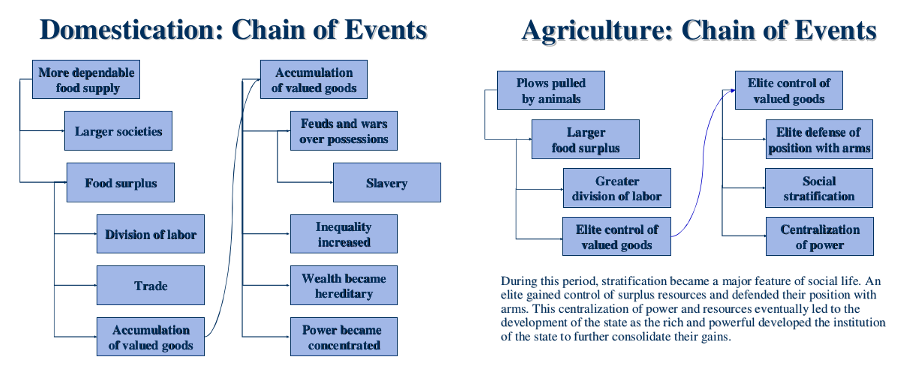
So how did this state of affairs come to be. Domination systems, dominator cultures, and hierarchical societies arose at the time of the Domestication revolution, approximately 8000 BC. According to this timeline, "The availability for the first time in human history of a dependable food supply ...made it possible to support larger societies. [...] food surpluses became common.... freed some workers to do other forms of work, such as crafts leading to the division of labor.
• Surplus food and crafts were traded with others. (Trade)
• Durable goods could now be saved and some people accumulated more than others. (Accumulation of valued goods)
• People now had possessions worth fighting over. (Feuds and wars over possessions)
• Captives from battles were forced to do less appealing work (Slavery)
• Some people accumulated much over time while others accumulated little. (Inequality increased)
• The wealthy wanted to pass their benefits on to their children. (Wealth became hereditary)
• Wealth and power became concentrated in the hands of a few. (Power becomes concentrated and chiefs, kings, and feudal society emerged)
With the agricultural revolution of 5500 BC, "The invention of the plow drawn by animals made agricultural production vastly more efficient than before permitting far more land to be farmed by fewer people. This resulted in an even greater food surplus. It also freed far more people for other types of work, creating an even greater division of labor. Jared Diamond details some of the additional specifics of the process.
According to Walter Wink, since the time of Babylon (1250 BC): "The story that the rulers of domination societies told each other and their subordinates is what we today might call the Myth of Redemptive Violence. It enshrines the belief that violence saves, that war brings peace, that might makes right. It is one of the oldest continuously repeated stories in the world."
Adam Smith is credited with promoting the modern version of "division of labor." Previously, division of labor meant some people worked on the farm, while others specialized in making various goods, but the craftsperson made the item in its entirety. In its modern form, division of labor means that many workers work on the same item, each rapidly performing a small simple repetitive operations on a production line. However, if you read his book, Wealth of Nations (1776), you will find that he actually denounces this form of division of labor. He wrote that it would make us "as stupid and ignorant as it is possible for a human creature to become." Personally, this is not what I want to become, but those in power in a domination system love the idea! "Division of labor" is just another way of saying "divide and conquer" because now no one worker knows even how to make the item in its entirety. Because each step was simple and a worker was easily trained, the workers themselves became an interchangeable part of the production line and easily replaced if necessary. The worker could now be paid less and so became even more powerless, and essentially a wage slave of the dominant few. Mohandas Gandhi said "Poverty is the worst form of violence."
Daniel Quinn puts a lot of this in a similar way (e.g.: "the knowledge of good and evil" is the idea that a person is capable of deciding "who should live and who should die"). There are many concepts that are intertwined here. Let's tease out some of the details...
Inequalities Based On Apparent Differences
When one divides "self" from "other" and starts seeing some as "more" and "less", then it can lead to all sorts of prejudices.
Two that probably arose immediately out of that ancient division were "sexism" (in the sense of sex/gender inequality founded on objectification) and "tribalism" (in the sense of small warring factions competing for the same "resources"). The idea of "chattel slavery" closely followed, but the concept of "race" was invented later, as nation-states grew and "slave trade" became "international". "Imperialism" and "colonialism" are the same kinds of patterns at larger scales and they are justified by the same types of ideologies (e.g.: "imperial cults", "divine right to rule", etc.).
Some of the works related to the field of "Gender Studies" lay out these patterns pretty well. To give a few examples:
• Daniel Quinn mentions Riane Eisler's The Chalice & The Blade [Summary]
• In the #Books channel on the Yesterweb Discord, Madness had mentioned Gerda Lerner's The Creation of Patriarchy [Summary]
• Another really interesting one is Peggy Reeves Sanday's Female Power and Male Dominance [Summary]
Such inequalities are rooted in personal language and perception. For that reason, they might seem intractable, but they can be resolved to the extent that people can dialogue with one another. Learning about the experiences of others can expand one's point of view and increase empathy.
Inequalities Based On Differing Skills & Technologies
As technologies develop and knowledge becomes more specialized, people often organize into systems that follow the same types of hierarchies. The open sharing of knowledge, especially how to build or invent your own technologies, helps to break that pattern.
Daniel Quinn mentions both "agriculturalists" (i.e.: those who plant crops) and "pastoralists" (i.e.: those that herd grazing animals). The thing that they have in common is "domestication" (i.e.: control over plant and animal reproduction for human purposes). In some instances, it can quite literally be thought of as a form of slavery and/or genocide (like in the modern era, there are "factory farms", "patented seeds", etc.).
However, it is possible to do agriculture in a way that is respectful to plants, animals, and the environment in general. There were ancient peoples who practiced something like this too.
Inequalities Based On Abstractions (Like "Wealth" & "Status")
Currency of any kind is worthless, but people try to use it as:
1. a "medium of exchange" (i.e.: something traded for "goods and services")
2. a "form of identification" (i.e.: a representation of what someone "has" or "does")
It is a technology that does not scale, and it will quickly fail to fulfill either of those functions if we try. One of the reasons for that is because it is a symbol which is easily mistaken for the things which people attempt to symbolize through it. Lewis Mumford offers a particularly clear explaination (italicized emphasis mine):
...He points out, for example, that the development of money (as a technology) created, as a side effect, a context for irrational accumulation of excess because it eliminated the burdensome aspects of object-wealth by making wealth abstract. In those eras when wealth was not abstract, plenitude had functioned as the organizing principle around its acquisition (i.e., wealth, measured in grains, lands, animals, to the point that one is satisfied, but not saddled with it). Money, which allows wealth to be conceived as pure quantity instead of quality, [...] ...can spiral out of control.
It is interesting to note that the ideas of "credit" and "debit" (and the entire concept of "banking" that arises out of that) is believed to have been invented in ancient Babylon. If one has some patience, some interesting examples of how that system was abused can also be found within the bible. There is a reason why "usury" (i.e.: the charging of "interest", using "money" itself to "make more money") is considered a "sin". It can become a form of enslavement.
Summary
Some of the most divisive patterns in human thought can be traced back to the beginning of "civilization" in The Fertile Crescent, and one can see them repeat throughout history all around the world. For example:
Compare the appearance of "domestication" and "agriculture"...
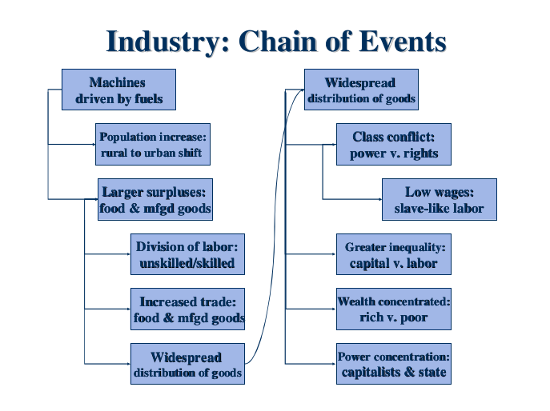
...to the appearance of "industry" and "capitalism"...
[The above diagrams are from this document.]
It may seem like it is so embedded within people's minds that it is inescapable, but that is only a habit. A more constructive way is possible if we take it step-by-step. There is so much more that could be said, but I will stop there for now.