| Stage of Cycle | Length | Description |
|---|---|---|
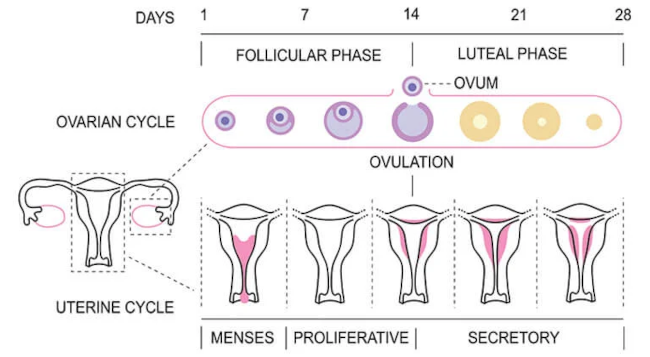
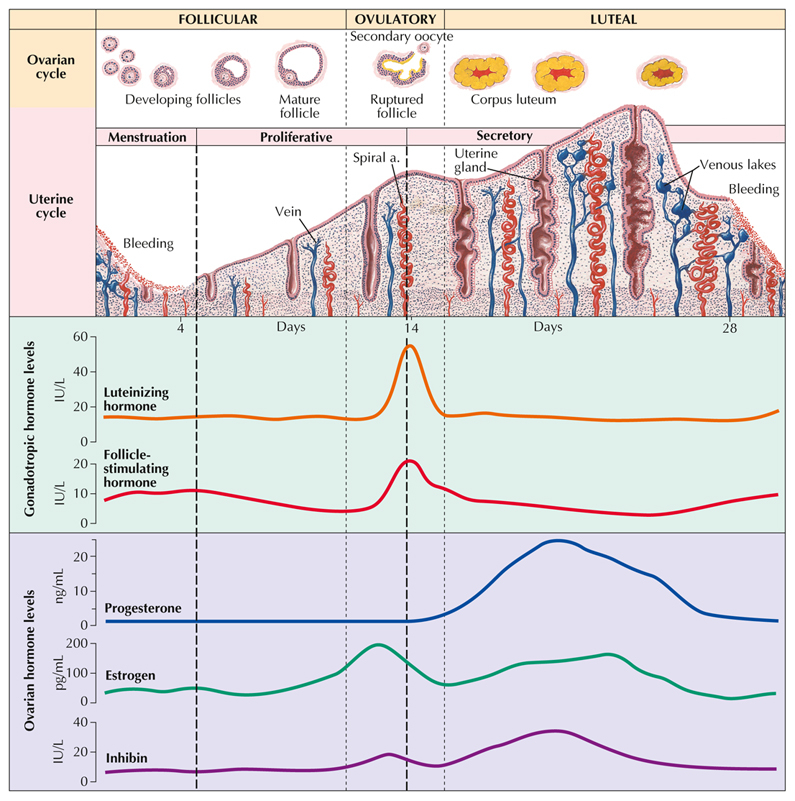
The Follicular Phase |
approx. 7-10 days long | The ovaries contain follicular cells. Each follicular cell contains an immature egg or oocyte. The follicular cells grow and mature during this phase. |
The Ovulation Phase |
usually lasts 3-5 days, the "fertile window" | This is when a single follicular cell ruptures and releases a mature egg, a secondary oocyte, that is capable of being fertilized. If two are released simultaneously, then twins are possible. |
The Luteal Phase |
approx. 14 days long | If the secondary oocyte is not fertilized, it is transformed into a corpus luteum cell. It will degenerate over time within the fallopian tube that connects the ovaries to the uterus. |
| Stage of Cycle | Length | Description |
|---|---|---|
Menstruation, or Menses |
approx. 3-7 days long | This is the phase that everyone is familiar with. It is when the endometrium, or uterine lining, starts to shed. It begins the first day of full bleeding. On average, about 25-80 milliliters of blood is lost. For reference, a fully soaked regular tampon/pad holds ~5 milliliters. |
The Proliferative Phase |
During this phase, a new layer of the endometrium grows. | |
The Secretive Phase |
This corresponds with The Luteal Phase of The Ovarian Cycle above. The endometrium takes on a form that makes it more receptive for a fertilized egg to become implanted within it. |
| Texture and Color of Menstrual Blood | (with examples of risk factors in parentheses) |
|---|---|
| excess estrogen, related to symptoms of PMS | |
| low progesterone, related to symptoms of Perimenopause (perhaps trouble with infertility) | |
| low estrogen, related to symptoms of Menopause (perhaps fatigue, a risk for bone fracture) | |
| relatively balanced hormones |
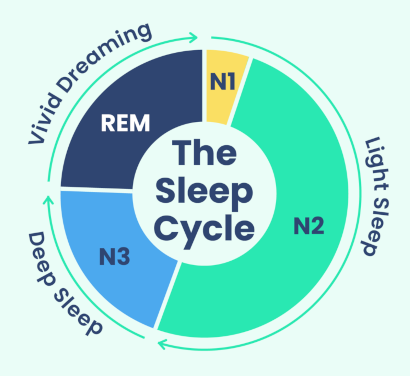
"In your particular case, I want to tell you about a discovery attributed to Dr. John Rock, one of the developers of the birth-control pill. Dr. Rock had worked at a fertility clinic, for women who couldn't get pregnant. He had many patients who had very irregular menstrual cycles. Through observation, thinking about the problem, and trial and error, he came to the conclusion that for some women, proper exposure to light would regularize their cycles, with nothing else needed."Whatever the case may be, there is no question that the quality of our sleep affects the quality of our life. Sleep itself can generally be broken down into four stages:
"What do you mean, proper exposure?"
"It seems that some civilized lighting patterns are different enough from the natural state that our ancestors were exposed to for millions of years, that it makes a crucial difference for some women. I want to emphasize some; like many other influences on health, people have wide degrees of sensitivity.
But to get back to particulars: Before you try mineral supplementation, I'd like you to get the smallest light bulb you can find -- 15- or 25-watt is fine -- and turn it on in your bedroom overnight on the fourteenth, fifteenth, sixteenth, and seventeenth nights after the first day of your next menstrual period, whenever that is. It needn't be right next to wherever you are sleeping -- just somewhere in the room. It doesn't have to shine right in your eyes, either. Do that every month for the next three or four."
"That'll work when I'm asleep, eyes closed?"
"It doesn't work for everyone, but I've asked many women to try it, when no other physical abnormality can be found. It works for 40 to 50 percent, at least in those I've been able to keep track of. It certainly can't hurt."
| Stage of Cycle | Approximate Duration |
|---|---|
| Non-Rapid Eye Movement (N1) | |
| Non-Rapid Eye Movement (N2) | |
| Non-Rapid Eye Movement (N3) | |
| Rapid Eye Movement (REM) |